Inventing attributes that sound like your own people
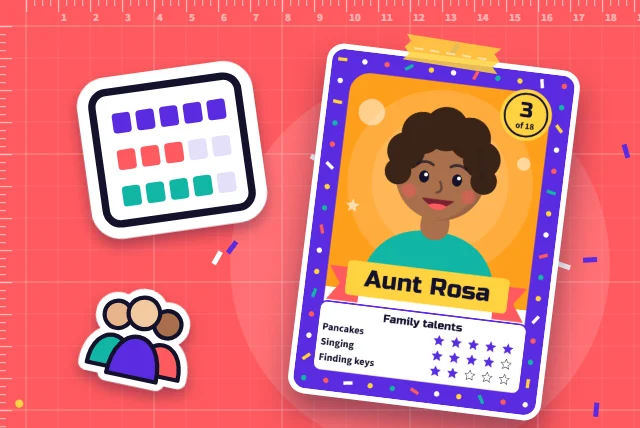
Grandpa can find a missing sock faster than anyone at home. Your neighbor’s boy can name every bird at the feeder. Neither talent appears on any official list, and that is exactly why they make wonderful card attributes.
An attribute is one row in a stat box: a short label and a level from 0 to 5. The levels are easy. The labels are where a card turns from generic into unmistakably theirs. “Strength” could belong to anybody. “Jar opening” belongs to the one person everyone hands the pickles to.
Know what makes a label feel personal
Before inventing anything, it helps to know what you are looking for. A label that works usually passes three small tests.
- You can picture it happening. “Pancake flipping” is a scene. “Talent” is a fog.
- The person would recognize it and not mind seeing it printed.
- A higher level clearly means more of something good or something funny in a gentle way.
The third test catches labels that run backwards. “Messiness: 5” reads as praise to one child and as a scolding to another. If you have to explain which end of the scale is the nice one, rewrite the label so more is plainly better: “Creative piles” or “Happy mud time.”
Mine real moments for attribute names
Do not start by thinking of attributes. Start by remembering scenes. The brainstorming handout from the Writing Center at UNC at Chapel Hill suggests writing without judging first, and also putting related words into clusters so that themes show up. Both are handy here.
Take one sheet per person. Write their first name in the middle. Around it, jot moments, not adjectives: the day they fixed the tent zipper, the way they sing in the car, how they always save you the last strawberry. Then circle moments that belong together. A cluster with three or four items points to a real strength.
The table below shows how a remembered moment turns into a label. The first column is how you might say it at the dinner table. The second is what goes in the stat box.
| The moment you remember | The attribute label |
|---|---|
| He hunts down socks nobody else can see | Sock radar |
| She reads bedtime stories in five different voices | Story voices |
| He mends the gate, the kite and the lamp with tape | Tape repairs |
| She makes weekend breakfast for whoever turns up | Pancake flips |
| The dog hears the cheese drawer from the garden | Cheese hearing |
Shorten each label to fit one row
A stat row shares its width with the bars or stars beside it, so the label gets only part of the card. On a small card, plan for roughly 14 characters or fewer. Count spaces too.
The Purdue Online Writing Lab advises replacing several vague words with fewer, more specific ones. Watch what that does here:
- “Is really good at finding things” (32 characters) becomes “Key finding” (11).
- “Tells stories at bedtime with voices” (36 characters) becomes “Story voices” (12).
- “Can fix almost anything with tape” (33 characters) becomes “Tape repairs” (12).
Each short version is also more vivid. Drop “is,” “can,” “always” and “really” first. The level already says how much, so the words do not need to. If a label still runs long, put one strong noun in place of the whole phrase. “Knowing the names of birds” can be “Bird names.”
Keep the wording style steady inside one card. If three labels are two-word nouns and the fourth is a full command like “Never skips dessert,” the odd one out looks like a mistake.
Choose shared and personal attributes for a set
One card can be as peculiar as you like. A set of cards needs a plan, because people will line them up and look across.
There are two honest approaches. In the first, every card has different labels. Nothing can be compared, and each person gets rows that suit only them. In the second, every card shares the same labels, such as “Snack skills,” “Story time,” “Garden help” and “Silly dances.” This is fun to read side by side, but it puts people in a line, so give it thought.
A middle way often works best: two shared rows that everyone is good at in some way, plus two rows that are theirs alone. For a family of four, that means two labels you write once and eight personal ones. The shared rows tie the set together, and the personal rows give each card its own surprise.
If any shared row could leave someone looking weak, change it. A child who is not yet reading should not receive a low “Reading” bar next to an older cousin’s full one.
Enter them and set the levels
In Card Workshop, add a stat box from the piece drawer, choose bars or stars, and type your own attribute names. Levels run from 0 to 5, and a box can hold up to 8 rows. The tool shows a tip when there are more than 5 attributes, which is a useful nudge to cut.
Set the levels with a little theater. If every row is a 5, the card has no shape. A card with one 5, two 4s and one cheerful 2 tells a better story: “Cooking: 2” beside “Cheering for the cook: 5” gets a laugh without hurting. Only do that when the person enjoys the joke about themselves.
Two choices come next. Decide between bars and stars, and check how many rows your card size can hold. If you have not named the card yet, the same memory sheet is the quickest source for a name and title.
Common mistakes
- Using vague labels such as Power or Skill
- Name the scene instead, like Jar opening or Map reading.
- Writing a label where a high level is a complaint
- Turn it around so that more always reads as cheerful, or leave it out.
- Letting a label wrap onto a second line
- Cut filler words or pick a single stronger noun.
- Copying the same rows onto every card without thinking about who looks weak
- Mix two shared rows with personal ones, or give every card its own labels.
Questions and answers
Do attribute levels have to be realistic?
No. They are a bit of affectionate storytelling, not a measurement. Just make sure the person would enjoy the story.
How do I invent attributes for someone I do not know well?
Ask two people who do. Use the question “What do they always do?” and write down their exact words.
Can the labels be funny?
Yes, as long as the person is in on the joke. Humor about habits tends to land better than humor about looks or abilities.
What if two people deserve the same label?
Use it for one and find a neighbor for the other, such as Pancake flips and Waffle timing.
Sources
- The Writing Center, UNC at Chapel Hill: Brainstorming (checked November 27, 2026)
- Purdue Online Writing Lab: Concision (checked November 27, 2026)
Found a mistake? See how corrections work.