Keepsake cards for grandparents: a small present made of shared moments
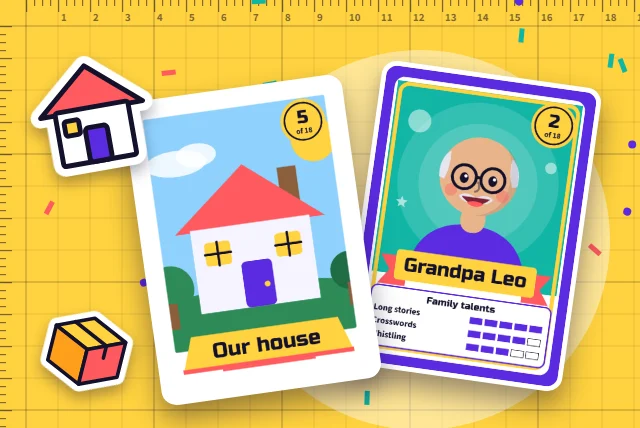
Some refrigerator doors run out of magnets long before the family runs out of pictures. One more loose print would only slide in behind the others. A small set of cards behaves differently: it has an order, a beginning and an end, and it can be held in one hand and read slowly from a favorite chair.
The present works when it feels chosen. Eight or twelve cards that each carry one shared moment say more than forty snapshots with nothing written on them.
Pick a thread that ties the cards together
Before opening any photo folder, finish this sentence: “These cards show…”. The answer is your thread, and it tells you which pictures belong.
| Thread | What each card shows | Likely count |
|---|---|---|
| A year in small moments | One moment from each month | 12 |
| Everyone who thinks of you | One portrait per grandchild or household | One for each |
| Things you taught us | Hands, tools, a recipe in progress, a garden bed | 6 to 9 |
| Then and now | An old picture on the front, the same spot today on the back | 4 to 6 |
If a lovely picture does not fit the sentence, save it for another occasion. A thread that stays narrow is what makes a few cards feel complete.
Choose pictures that show one particular person
Tate describes a portrait as a representation of a particular person. Let each card be particular too: not “the kids”, but one child holding one wooden spoon at one table. In Card Workshop, zoom and move the picture inside the window until the face, or the busy hands, fill most of it.
A portrait does not have to be a photograph. Tate also notes that a self-portrait can be abstract or symbolic, in any medium. A grandchild’s crayon version of themselves, or a drawing of their muddy boots, can stand in for a face. A grandparent may well treasure that card most. To get the artwork in cleanly, see how to photograph a drawing.
Check who else is in each frame. If a picture shows a friend or a cousin from another household, ask that family before printing it.
Size the set for comfortable reading
Pick the size by thinking about eyes and hands first, paper second. This is what a set of 12 needs on letter paper.
| Size | Per sheet | Sheets for 12 | Feels like |
|---|---|---|---|
| Large 3.5 × 5 in | 4 | 3 | Small prints that can stand on a shelf |
| Square 3 × 3 in | 6 | 2 | Roomy for pairs of faces |
| Classic 2.5 × 3.5 in | 9 | 2 | Easy to hold as a stack |
| Mini 2 × 3 in | 12 | 1 | Tiny, best with very little text |
For many grandparents, Large is the kind choice: faces are bigger and words have room to breathe. Whatever you choose, take the tool’s tips seriously when it says text will print very small or a photo has too few pixels for its printed size. Both problems are much easier to fix now than after cutting. Our note on type that stays readable goes further.
Write the back as a short note
The front catches the eye. The back is what gets reread. Name something the grandparent did, said or would instantly recognize.
| Before | After |
|---|---|
| Fun at the park! | You held the kite string until our arms were long enough to take over. |
| Love from all of us. | Saturday pancakes are still the ones we compare all others to. |
| Our garden. | The tomatoes you showed us how to tie are taller than the fence post now. |
Two lines are plenty. Sign with a first name or family nickname, and leave out ages, birthdays and addresses. When you print fronts and backs, choose whether the paper flips on the long edge or the short edge to match your printer, and run the line-up test sheet before using good paper. If the backs land slightly off, the small adjustment setting can move the back side.
Present them so they last
Think about where the cards will live: tied with ribbon, in a small box, in an album, or a few at a time on a shelf. The National Archives explains that exposure to light can fade and darken items, and recommends showing copies while originals stay boxed. Your cards are prints made from files you still have, so display one set and keep a spare in the box.
For an album, its storage guidance favors mounting without glue, using corners made of non-acidic paper or of stable plastics such as polyester, polypropylene or polyethylene. It lists the self-stick “magnetic” style of album among materials to avoid.
- Every card has a name or title, spelled the way the family spells it.
- Faces still look clear on the printed card at reading distance.
- One cut pair has been checked to confirm front and back agree.
- Each grandchild or household appears at least once.
- A project copy is saved in case a card ever needs reprinting.
For a trip you took together, trip memory cards make a natural second set. If the present is meant for a big visit with the whole clan, compare it with a set for a family gathering.
Common mistakes
- Choosing only the neatest posed pictures
- Pick pictures of moments you shared. A messy kitchen is often the part they enjoy looking at.
- Shrinking a long message until it fits
- Cut the note to two short lines and save the rest for a letter slipped into the box.
- Giving some grandchildren far more cards than others
- Count how often each child or household appears and even it out before printing.
- Gluing the finished cards onto album pages
- Use photo corners or pocket pages so the cards can be lifted out unharmed.
Questions and answers
How early should the work begin?
Two or three weeks ahead leaves room to ask relatives for pictures, print a test sheet and redo anything that looks off.
Can the cards be sent by mail?
Yes. Stack them between two pieces of thick cardboard so the corners stay flat, and keep your project file in case the envelope goes astray.
What suits a grandparent with low vision?
Use the Large size, a few big words, strong contrast between lettering and background, and one clear subject in each picture.
Can old family pictures go on these cards?
Yes, as copies. Photograph or scan the print, put the original somewhere safe and place the copy on the card.
Sources
- Tate: Art term: portrait (checked November 27, 2026)
- National Archives: Displaying family papers and photographs (checked November 27, 2026)
- National Archives: Storing family papers and photographs (checked November 27, 2026)
Found a mistake? See how corrections work.