Memory cards from a trip: choose a dozen moments and give each one a card
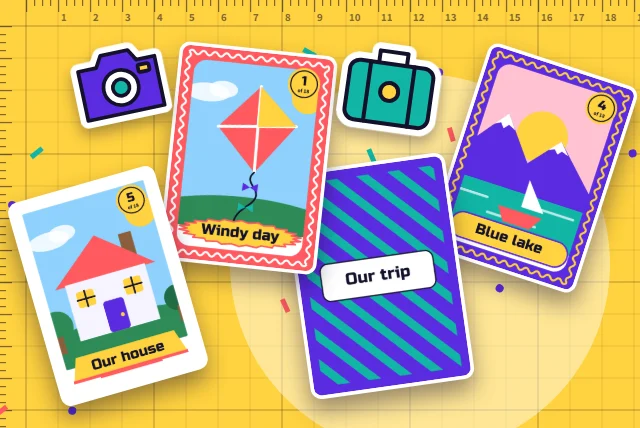
The camera roll says 412 pictures, and 31 of them are the same lighthouse from slightly different steps. Somewhere among the rest is the afternoon everyone got caught in the rain and ate squashed sandwiches under a bus shelter. Which of those do you want to hold in your hand a few years from now?
A card set forces a kind of choice that a folder never does: a small number of moments, each with one picture and a few words. The sorting takes more care than the design, so begin there.
Gather and thin the pictures first
The Library of Congress advice on personal digital photos starts with finding all of them, on cameras, computers and memory cards. It then suggests picking the ones that matter most, keeping the highest quality version when there are several, and giving files descriptive names. That order works well for a trip.
- Copy pictures from every traveler’s device into one folder.
- Make a second folder called something like “for-cards” and copy, never move, your candidates into it.
- From each burst of near-identical shots, keep just one.
- Stop when you have about twice as many as you need, then cut in half.
For a set of 12, that means narrowing 412 pictures to roughly 24, and 24 to 12. The first cut is fast. The second is where the conversation happens, and it is the enjoyable part.
Choose moments, not a list of sights
A set of famous views could belong to anyone. A set of moments could only belong to you. Here is one shape for a five-day trip.
| Cards | What they hold | Example |
|---|---|---|
| 1 | Opening card | A hand-drawn route and the trip’s nickname |
| 2 to 11 | Two for each day | One wider view, one small detail or mishap |
| 12 | Coming home | The mountain of laundry |
Twelve cards fill one sheet of letter paper in Mini size, or take two sheets in Classic size with six spaces left. Let every traveler nominate at least one moment, including the youngest. Children often remember the ferry stairs better than the castle at the top of them.
Fit wide views and small details onto a card
Tate counts landscape among the principal types of subject in Western art, and a trip tends to fill your folder with it. The difficulty is that most card sizes stand tall, while a coastline runs sideways. Three approaches help.
- Use the Square size when width matters across the whole set.
- Zoom and slide the picture inside the window to one strong part, such as the lighthouse and a band of sea.
- Pair a wide view with a close detail on the back, like the shell from that same beach.
Watch the zoom. Suppose a photo is 4000 pixels wide. If a quarter of that width, 1000 pixels, fills a window 2 in wide, you have 500 pixels per inch, which is ample. If you zoom until only 300 pixels fill the same window, you have 150 pixels per inch and the print is likely to look soft. The tool shows a tip when a photo has too few pixels, and pixels for card photos explains the sums. You can also turn a picture by 90°, which rescues files that arrived sideways.
Write captions while the details are fresh
For digitized family items, the National Archives suggests recording who, what, where and when. Those four questions also make a reliable trip caption.
| Thin caption | Caption with the four facts |
|---|---|
| Beach day! | Third morning, north beach. Dad dug the moat; the tide had it by lunch. |
| Yummy. | Last evening. Grandpa and Noor shared the burnt flatbread on the balcony. |
Keep places general. A beach or a town is plenty, and the address of where you stayed, or of home, has no place on a card. Write rough notes within a week even if the set will wait for months.
Order the set and keep it safe
In Card Workshop, build one card, duplicate it, and drop in a picture and caption for each moment. Arrange the collection in the order things happened, add the number badge and, if you like, give each card a group such as “Day 2” so you can filter by day. A back design with the trip’s nickname as its title ties them together.
The Library of Congress also advises keeping at least two copies of your chosen photos, stored in different places. Keep your selected pictures together with a downloaded project copy, so the set can be reprinted after a spill.
The finished set makes a warm present for grandparents who stayed behind. If your travels were full of beetles and seed pods, a separate batch of nature find cards keeps those from crowding out the people. To keep all twelve looking related, read about consistent sets.
Common mistakes
- Making a card for every well-known sight
- Keep a sight only if something happened there, and add shared meals, wrong turns and quiet moments.
- Zooming deep into a distant subject
- Pick a closer picture, or leave the subject small and name it in the caption.
- Putting off captions for months
- Record who, what, where and when in rough notes during the first week.
- Deleting the other pictures once the cards are printed
- Keep your originals. The cards are a selection, not a replacement.
Questions and answers
How many cards suit a weekend away?
Six to nine. Nine fill one Classic sheet exactly, and six fill one Square sheet.
What about strangers in the background?
Prefer pictures where people you do not know are not recognizable, or zoom and slide the image so they fall outside the window.
Can the tool brighten a dull picture?
No. It has no filters or color correction, so choose the best-lit version or adjust a copy in another program before adding it.
What if the best moment has no photo?
Draw it, or photograph an object connected with it. A sketch of that bus shelter can carry the rain story perfectly well.
Sources
- Library of Congress, Digital Preservation: Digital photos: personal archiving (checked November 27, 2026)
- National Archives: Digitizing family papers and photographs (checked November 27, 2026)
- Tate: Art term: landscape (checked November 27, 2026)
Found a mistake? See how corrections work.