A photo card set for a family gathering that helps people place each other
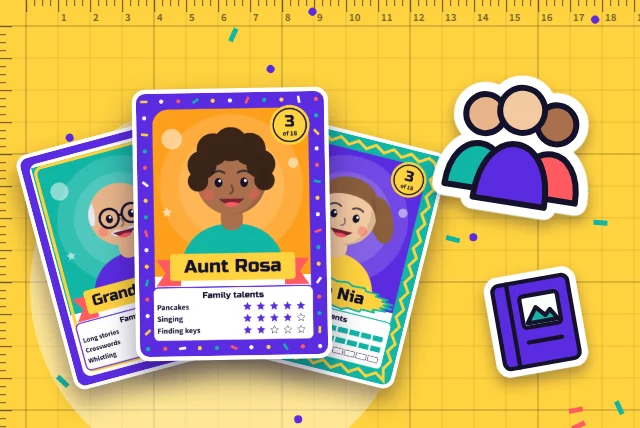
At the third table, two people who share a great-grandmother are politely trying to work out how. One remembers a house with a green porch. The other remembers a very loud dog. A small card with a face, a first name and one line about where that person fits would have settled it in ten seconds.
That is the quiet job of a card set at a family gathering. It gives people a reason to start talking and something to carry home afterward. You can plan one in an evening, as long as you decide what the cards are for before you collect a single picture.
Give the set one job
A set that tries to be a family tree, a photo album and a party game all at once gets crowded fast. Pick the main job and let the front and back follow from it.
| Main job | On the front | On the back |
|---|---|---|
| Who is who | Face and first name or nickname | One line of connection, such as “June’s sister, Theo’s aunt” |
| Conversation starter | Face and three invented attributes | One question to ask this person |
| Memory of past gatherings | A picture from an earlier year | Two lines about what was happening |
“Who is who” is the easiest first set, because every card answers the same question. Write the connection line so a stranger could use it. “Part of the lake branch, married in, great cook” makes the reader decode three things. “June’s sister. Ask her about the peach pie” tells them where she fits and gives them a first sentence to say.
Count people, cards and sheets
Type or write a list of everyone who will get a card, one name per line, then choose a size with the sheet count in view. Here is the same list of 26 people printed on letter paper in each size.
| Card size | Cards per sheet | Sheets for 26 cards |
|---|---|---|
| Classic 2.5 × 3.5 in | 9 | 3 |
| Mini 2 × 3 in | 12 | 3 |
| Square 3 × 3 in | 6 | 5 |
| Large 3.5 × 5 in | 4 | 7 |
With Classic cards, three sheets hold 27, so there is one spare space for a title card with the date of the gathering. Think about copies as well. If five households each take home a full set, three sheets turn into fifteen, and someone has to cut them all. Decide that number now rather than the night before.
Collect pictures and facts weeks ahead
Ask each household for one picture per person that the person is happy with. Say plainly that it will be printed and passed around among relatives. Use only pictures you took or have permission to use, and ask a parent before including a child.
As files arrive, borrow a habit from the National Archives advice on digitizing family items: add basic information about who, what, where and when. A short note such as “June, at the stove, summer visit” is enough, and it often becomes the line on the back of the card. Keep the “where” general.
Printed photos from albums need a copy first. The same advice points out that a digitized item can be viewed and shared without handling the original. Our guide to old family photos on cards walks through the copying.
For attributes, try the listing method from the brainstorming handout of the UNC Writing Center, which was written for students but works at any kitchen table. Write a person’s name at the top and jot down every word or phrase connected with them. Then keep the two or three that are both kind and specific. “Remembers every nickname” beats “nice”.
Build the set in Card Workshop
- Open Card Workshop, pick your size and finish one complete card: a photo, a name banner and a frame.
- Duplicate that card in the collection for each person, then replace the picture and the name.
- Give every card a group, such as “June’s side” or “Theo’s side”. Filter by group to see who is still missing.
- Put the cards in an order people will understand, for example branch by branch, and add a number badge so a missing card is easy to notice.
- On the back side, use one back design with a shared title such as “Summer gathering”.
Copying one finished card keeps banners and frames lined up across the set. For the finer points, see how to keep a whole set consistent.
Put the cards to work on the day
- Set each card at a seat as a place marker, then let people take their own home.
- Give each child three cards and ask them to find those people and learn one new thing.
- Lay the whole set on a side table, branch by branch, as a loose family map that guests can rearrange.
If relatives bring original photographs to show, keep an eye on the light. The National Archives notes that all light can cause fading and darkening, and suggests displaying copies while the originals stay in a box. Your cards are copies, so they can sit on a bright table all afternoon.
Want guests to add cards of their own during the visit? Set up a card-making table. And if the eldest relatives deserve a special set, plan separate keepsake cards for grandparents.
Common mistakes
- Collecting pictures before deciding what the set is for
- Choose one job first, such as showing who is who, then ask relatives only for what that job needs.
- Writing a long family history on the back
- Keep one connection line and one question. Longer stories belong in a booklet, or are better told out loud.
- Forgetting partners and newer members of the family
- Check your card list against the guest list instead of your memory, and make cards for newcomers too.
- Printing a single set for a large crowd
- Count the households that will want one and print enough sheets, or decide in advance who prints extras later.
Questions and answers
Should relatives who cannot come still get a card?
Yes, if they are happy to be included. Their card can sit on the table during the day and be sent to them afterward.
What if someone does not want their photo used?
Respect that. Offer a card with a drawing, a favorite object or just a first name and an icon, or leave them out if they prefer.
How many cards make a good set?
As many as the job calls for. Nine cards for one generation feel complete, and thirty are fine if you have time to check each one.
Can children help make the cards?
They can pick icons, invent attribute names and draw pictures. An adult should look after photos of other people, the printing and the cutting.
Sources
- National Archives: Digitizing family papers and photographs (checked November 27, 2026)
- National Archives: Displaying family papers and photographs (checked November 27, 2026)
- The Writing Center, UNC at Chapel Hill: Brainstorming (checked November 27, 2026)
Found a mistake? See how corrections work.