Class memory cards for the last week of the school year
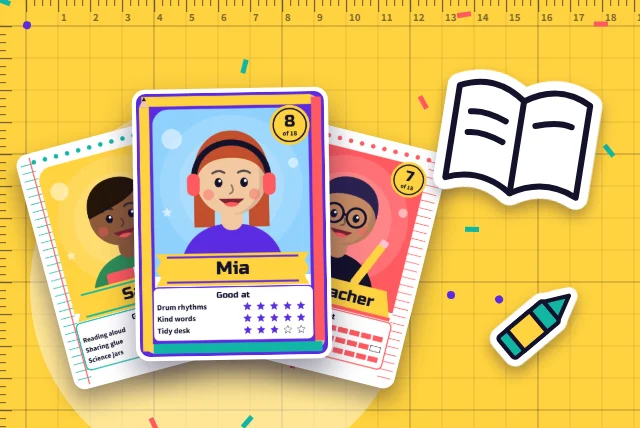
In the final week the classroom walls start coming down. The paper caterpillar goes to recycling, the reading chart is rolled up, and somebody finds a mitten that has been missing since the cold months. A set of small cards can hold on to part of that year after the room is bare.
For teachers and classroom helpers, the puzzle is making something personal for every child while keeping personal details out of it. Both are possible if the rules are settled before the first card exists.
Settle what never goes on a card
Cards travel. They end up in backpacks, on refrigerators and in other families’ photos. Write your limits down first and share them with anyone who helps.
| Fine to include | Leave off |
|---|---|
| A first name or a nickname the child likes | Surnames |
| A drawing, or a photo the family has agreed to | School name, room number or address |
| A class moment everyone shared | Ages and birthdays |
| A kind strength, chosen with the child | Anything about health, grades, behavior or home |
Follow your school’s own rules for pictures of children, and tell families how the cards will be made and who will receive them. For the shared back, use a title about the year, such as “Our season of seedlings”, instead of anything that identifies the building.
Offer drawings as an equal choice
Some families will say no to photos, and some children dislike being photographed. If a drawn portrait is offered to everyone from the start, nobody’s card looks like the exception. A mix of photos and drawings can also be avoided completely by asking the whole class to draw.
Tate names ink, pencil, crayon, charcoal and chalk as the materials used most often for drawing. In a busy room, dark pencil, ink pens and crayon on white paper are the easiest to manage. Ask children to go over pale lines, because faint marks can disappear when a picture is printed small.
A sheet cut to 5 × 7 in has the same shape as a Classic card at twice the width and height, so art made on it shrinks neatly. Collect the drawings in one folder with the child’s first name on the reverse, then photograph each one flat in the same spot.
Collect the memories out loud
The brainstorming handout from the UNC Writing Center describes listing and clustering ideas, and notes that a group can work on a board or large paper so there is room for everyone. It was written for writing assignments, yet it suits this job well.
- Write “Our year” in the middle of the board.
- Give the class ten minutes to call out anything they remember, and write it all down.
- Circle related items together: the worm bin, the class play, the day of the big puddle.
- Let each child choose one cluster, then say one sentence about it.
That sentence goes on the back of the card, in the child’s own words where possible: “Mila kept the bean plant going through the long weekend.” Prepare one kind strength per child yourself beforehand, so no card is left with a vague line. Our guide to kind wording about real people helps with phrasing.
Size the job before you start
Take a class of 24 with one extra card for the teacher: 25 cards. One complete set needs the following on letter paper.
| Size | Per sheet | Sheets for one set | Spare spaces |
|---|---|---|---|
| Classic 2.5 × 3.5 in | 9 | 3 | 2 |
| Mini 2 × 3 in | 12 | 3 | 11 |
| Square 3 × 3 in | 6 | 5 | 5 |
| Large 3.5 × 5 in | 4 | 7 | 3 |
If all 24 children take home a full Classic set, that is 72 sheets of fronts alone, and 600 cards to cut apart. A lighter plan is to fill one sheet with a child’s own card, which gives them nine copies to share with friends and family, for 24 sheets in total. Another is to hand each child their single card and display one full set on the wall, uncut.
Estimate your time the same way. If a card takes about four minutes to type and check, 25 cards take 100 minutes, which is better spread over several afternoons.
Build, check and clear the computer
Open Card Workshop and make one model card with a frame from the Classroom style, a name banner and a back design. The built-in Class sample set is a handy place to look for layout ideas. Duplicate your model once per child, then add pictures and names while reading from the class list.
Give cards a group, such as table groups, so you can filter and proofread six at a time. Print one test sheet and look for cut-off letters before printing the rest.
Work is saved only in the browser you are using, and pictures are not uploaded. On a shared computer, that still means the next user could open it. When you finish, download a project copy to storage only you control, then choose “Delete saved work”.
For a steadier look across all 25, read about keeping a set consistent. If you would rather make the cards together as an end-of-year activity, borrow the station layout from our card-making table guide.
Common mistakes
- Making cards only for children whose families allow photos
- Offer a drawing or object card to every child, so the finished set has no visible gaps.
- Printing the school name or room number on the back
- Use a title about the year or a shared class project instead.
- Using stat boxes with stars that rank children
- Leave stat boxes off, or give every card the same level and change only what the row is called.
- Leaving the cards on a shared classroom computer
- Save a project copy to your own storage, then delete the saved work from that browser.
Questions and answers
Can children design their own card?
They can choose an icon and colors, name their strength and draw the picture. An adult should place photos, check wording and handle printing.
What if a child joins late in the year?
Duplicate the model card, add the name and a memory from their first weeks, and add the card to your next print run.
Should the teacher have a card too?
Many classes enjoy it. Keep it in the same style, with the name the children already use in class.
Is a whole-class group photo a good idea?
Only if every family shown has agreed. A group drawing or a picture of the class garden avoids the difficulty.
Sources
- Tate: Art term: drawing (checked November 27, 2026)
- The Writing Center, UNC at Chapel Hill: Brainstorming (checked November 27, 2026)
Found a mistake? See how corrections work.