Keep a whole card set consistent with a short plan and one master card
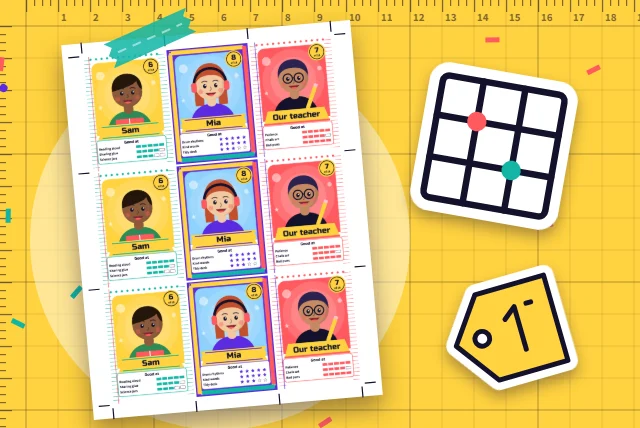
Lay nine finished cards side by side and every small difference speaks up. One name banner sits a little lower than the rest. Two greens that looked identical on screen turn out to be cousins. The seventh card has four attribute rows while the others have three, and your eye keeps going back to it.
None of those cards is wrong on its own. A set is seen as a group, so it needs a few decisions made once, written down and then copied faithfully.
Write a set plan in six lines
A scrap of paper is enough. Answer these six questions before the first card.
| Decision | Question | Example answer |
|---|---|---|
| Theme | What ties the cards together? | Everyone at our kitchen table |
| Size | Which one size will all cards use? | Classic 2.5 × 3.5 in |
| Count | How many cards? | 18 |
| Order | What decides which card is first? | Alphabetical by first name |
| Shared parts | What stays identical? | Frame, banner position, back |
| Changing parts | What differs from card to card? | Picture, name, three row names |
Count and size are linked by paper. Eighteen Classic cards fill exactly two sheets of letter paper. Twenty cards need three sheets and leave seven spaces empty. If your theme can stretch or shrink a little, aim for a full sheet. For help picking among the four sizes, see choosing a card size.
Make the theme specific enough to say no with. “Family” lets almost anything in. “Family members cooking something” tells you at once that the holiday portrait belongs elsewhere.
Build one master card and test it hard
Tate defines composition as the arrangement of elements within a work of art. In a set, you work out that arrangement once and then reuse it. In Card Workshop, build the master like this.
- Start with the longest name and the most awkward picture, not the easiest ones.
- Show the dashed cut-safe line and keep names, badges and text inside it.
- Write down the position, size and angle numbers of the shared pieces.
- Lock those pieces so they stay put while you work.
- Print the card alone and read it at actual size.
- Only then duplicate it in the collection, once for every other card.
If the banner can hold “Bartholomew”, it will hold “Bo”. The reverse is not true. Treat every duplicate as its own card: if you change a shared piece later, plan on making that change card by card. That is the reason to test first.
Give every element one steady job
Butterick’s Practical Typography says that mixing fonts is optional, and that it works best when each font keeps a consistent role in a document. The same thinking suits colors, shapes and corners on cards. Decide what each one means and do not let it drift.
- The top banner always holds the name.
- The upper right corner always holds the number badge.
- One accent color always marks the group.
- An icon, once it means “gardener” or “early riser”, means only that.
When color marks a group, add a word or icon too. WebAIM advises that color should not be the only method of conveying important information, since some people cannot tell certain colors apart.
Fewer rules are easier to keep. Four steady habits do more for a set than a long list that nobody remembers by card twelve.
Settle the order, then number
Choose a rule that a stranger could guess: alphabetical, group by group, or in the order events happened. The number badge shows a card’s number in the collection, so arrange the cards first and read through the badges after any reordering. Add later cards at the end if some of the set is already printed, so the numbers people hold stay true.
Groups help you check your work. Give each card one, filter to a single group and compare those cards closely before moving to the next. Ideas for labels are in numbering a collection and labeling sets.
Proof the set as a group
- All cards use the size written in the plan.
- Name banners sit at the same height.
- Frame colors look identical side by side.
- Names follow one style, such as first names or nicknames, not a jumble.
- Attribute boxes have the same number of rows, or differ for a clear reason.
- Every back carries the same design and title.
Print one sheet, cut it, spread the cards out and step back from the table. Differences that hide on a screen are obvious in a grid of paper. Fix them, save a project copy and then print the rest.
The plan adapts to any occasion. A family gathering set may order cards by branch, class memory cards keep the layout equal for every child, and trip cards follow the calendar.
Common mistakes
- Designing the first card around an unusually easy picture
- Begin with the hardest picture and longest name so the layout survives the rest.
- Adding a charming extra to only one card
- Give every card something equivalent, or save the idea for the next set.
- Reordering after printing and ending up with numbers that clash
- Fix the order before printing, and check every badge after any change.
- Switching sizes because one photo would look better larger
- Keep a single size and crop that photo differently.
Questions and answers
Must every card in a set look identical?
No. Shared parts hold the set together, while the picture, name and a few chosen details should differ.
How can a set grow later without looking patched?
Keep the plan and the project file. Start each addition as a duplicate of an existing card and place it last.
Is it fine to have two designs in one set?
Yes, if each has a clear meaning, such as one for people and one for pets, with the same size, back and banner position.
What fixes a card whose pieces have drifted?
Select each shared piece and type in the position, size and angle you noted from the master card.
Sources
- Tate: Art term: composition (checked November 27, 2026)
- Butterick’s Practical Typography: Mixing fonts (checked November 27, 2026)
- WebAIM, Utah State University: Color-blindness (checked November 27, 2026)
Found a mistake? See how corrections work.