Cards of the plants and creatures you notice outdoors
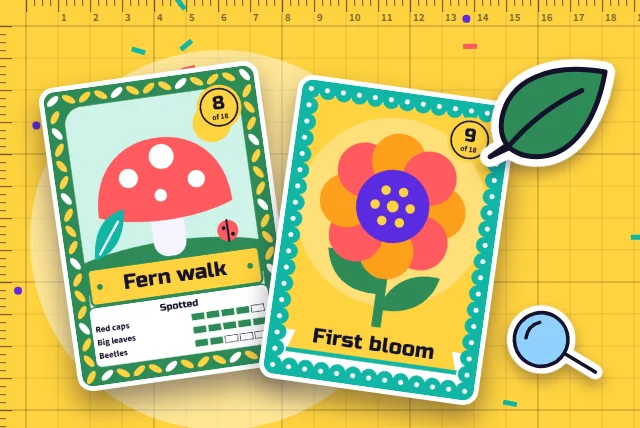
A snail crossing the porch step moves slowly enough that you can fetch a camera, disagree about which way it is heading, and still find it only halfway across. Small finds like this are easy to notice and just as easy to forget by dinner.
A nature find card keeps one of them: a picture or sketch, a plain description and where you saw it. Over a season, the cards become your own record of what shares the yard, the path or the windowsill with you.
Look closely and leave things where they are
The collection is made of pictures, so nothing living has to come home with you. Agree on a few habits before heading out.
- Photograph or sketch finds where they are; do not pick or carry them off.
- Do not touch what you cannot identify, and never taste a plant, berry or mushroom.
- Keep your distance from nests and burrows, and let an animal leave if it wants to.
- Follow the rules of the place and stay on paths where asked.
- Young explorers look together with an adult.
These habits keep you safe, and they leave the beetle on its leaf for the next person who looks.
Get close without losing the subject
Photography Life describes macro photography as close-up work on small subjects, such as bugs and flowers. Its guide warns that if the space between lens and subject is too small, you might scare the creature or block the light, and it stresses focusing on the most important part of the subject.
With a phone or simple camera, that translates into a short routine. Approach slowly. Stop as soon as the picture turns soft and ease back until it sharpens. Tap or aim to focus on an eye, the center of a flower or the edge of a leaf. Take several frames, because breezes and tiny legs spoil many of them.
You do not need the find to fill the original picture. A photo 3000 pixels wide, trimmed to its middle third, still has 1000 pixels. Across a window 2 in wide that is 500 pixels per inch, more than enough for a crisp card. So step back a little and use zoom inside the card window later.
Soft, even light shows texture without harsh glare. A bright cloudy morning is kind to shiny shells and pale petals. Check that your own shadow is not lying across the subject.
Sketch what the camera misses
Tate describes drawing as making images on a surface with lines, though drawings can also include areas of tone and washes. A thirty-second line sketch lets you record what a photo may blur: how many petals there were, how the veins branched, which way the legs bent.
It does not need to be handsome. Label one or two details with short arrows, then place the sketch on the back of the card while the photo takes the front. Flat, even copying keeps the lines clean, as explained in photographing a drawing. When a creature vanishes before the camera is ready, a sketch from memory made right away can be the whole front.
Record what you actually saw
| Card part | What to put there | Example |
|---|---|---|
| Name banner | A name if you are sure, a description if not | Small green beetle |
| Back, first line | Where, in general terms | On the mint by the step |
| Back, second line | When you saw it | A warm morning in June |
| Back, third line | What it was doing | Walking the rim of a leaf |
| Stat boxes | Playful impressions, levels 0 to 5 | Shine 5, Speed 2, Hiding skill 4 |
A guess written in large letters soon feels like a fact. “Small green beetle” is honest and useful, and you can type in a proper name after checking a field guide. Stat levels are your impressions rather than measurements, so a back title such as “What we noticed” sets the right tone. Leave exact home addresses off.
Grow the collection over a season
Open Card Workshop, choose a frame from the Nature style and build a first card you can duplicate for later finds. Add icons such as a leaf or sun, and give each card a group: “Leaves”, “Flowers” and “Creatures”, or one group per walking route. The collection filter then shows just one group, and the number badge shows each find’s number in the collection.
Print when a sheet is nearly full. Twenty finds in Classic size need three sheets with seven spaces empty; in Mini size they need two sheets with four empty. Download a project copy after a good outing, since work is otherwise kept only in your browser.
Finds made far from home may sit more naturally among your trip memory cards. Animals that live indoors with you get their own treatment in pet profile cards. For a season-long project, settle the layout early with the help of planning a consistent set.
Common mistakes
- Moving a creature to get a nicer background
- Move yourself instead, or accept the background and crop closer inside the card window.
- Labeling a find with a name you are only guessing
- Describe color, shape and place, and add a name once you have checked it.
- Pushing the lens so close that everything blurs
- Back away until the camera can focus, then enlarge the subject on the card.
- Saving all the finds for one enormous print day
- Print a sheet whenever one fills up, so layout problems show early.
Questions and answers
Is a special lens needed?
No. An ordinary camera or phone handles flowers, leaves and larger insects if you stay at a distance where it can focus.
What about creatures that move too fast?
Sketch them from memory straight away and write what you noticed. A drawn card belongs in the set as much as a photographed one.
Can a picture from the internet stand in for something you saw?
Better not. The set is about your own finds, and other people’s pictures need their permission. Draw it instead.
How do you keep the set interesting after the obvious finds?
Give a month its own theme, such as seed shapes, bark patterns or things spotted after rain.
Sources
- Photography Life: Everything you need to know about macro photography (checked November 27, 2026)
- Tate: Art term: drawing (checked November 27, 2026)
Found a mistake? See how corrections work.