Profile cards for the animals at home: what to put on each one
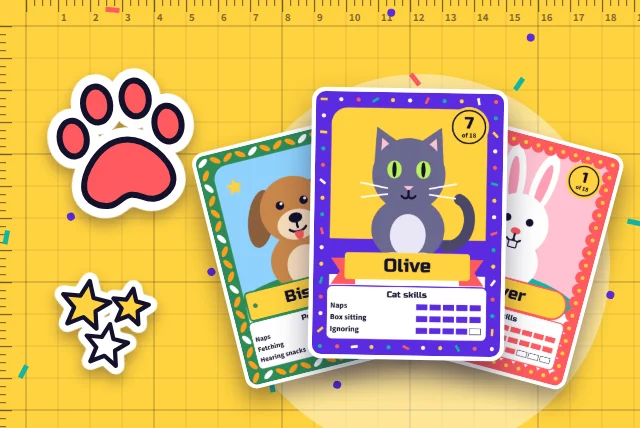
The rabbit has firm opinions about the vacuum cleaner. The old dog has opinions about the rabbit. The cat has opinions about everything and shares them at five in the morning. None of this is written down anywhere, and it is exactly what a profile card is made of.
A profile card is a small, honest description of one animal: how to recognize it, what it does and how to be kind to it. Make one for every animal at home and you have a set that children enjoy and a pet sitter can actually use.
Watch for a few days before you write
Memory tends to hand you the same words for every animal: cute, playful, hungry. Notes taken while watching are far better. The UNC Writing Center’s brainstorming handout offers a method with three viewpoints, meant for writing papers: describe your subject and what sets it apart, trace how it has changed, and map what it is connected to. It borrows nicely to a living room.
| Viewpoint | Ask yourself | Example note |
|---|---|---|
| Describe | What sets this one apart from others of its kind? | One ear stands up, one folds over |
| Trace | What has changed since it arrived? | Used to hide under the sofa, now sleeps on top |
| Map | What or whom does it react to? | Runs to the door at the jingle of keys |
Leave a notepad near the favorite napping spot and add a line whenever something makes you smile or sigh. Three days is usually enough to fill a page.
Turn the notes into card parts
Each part of a card has a different job, so sort your notes among them instead of squeezing everything into one text box.
| Card part | What goes there | Example |
|---|---|---|
| Name banner | The name the household really uses | Biscuit |
| Picture window | Face or a typical pose | Chin resting on a slipper |
| Seal | A made-up title | Chief of Naps |
| Stat boxes | Three to five habits with levels | See below |
| Back | Short description and care notes | Where he hides, what calms him |
Card Workshop includes a ready-made Pets sample set, which is a quick way to see one arrangement before you change it. Icons such as a paw, a fish or a sun can mark what kind of day the animal likes best. Getting a sharp picture of a creature that will not hold still is its own skill, covered in photographing pets for their cards.
Name traits only this animal could have
A good trait row makes someone who knows the pet say “yes, that’s him”. Compare “Friendly” with “Greets the mail carrier’s shoes”. Compare “Active” with “Midnight hallway laps”. You choose the row name and set the level from 0 to 5, shown as bars or stars.
Here is a finished example for a dog named Biscuit:
- Nap talent: 5
- Doorbell alarm: 4
- Fetch follow-through: 2
- Bath patience: 1
Low numbers are part of the charm when they are said with affection. Stop at four or five rows; the tool shows a tip once a card has more than five, and the card reads better with breathing room.
Make the back useful for a pet sitter
The Purdue Online Writing Lab observes that more specific words lead to more concise writing, which is just what a small card needs. Here is a care note before and after.
| Before (20 words) | After (10 words) |
|---|---|
| Biscuit can be a bit nervous sometimes when there are loud noises and things like that, so please be careful. | Hates fireworks. Hides behind the washer; let him stay there. |
- Favorite hiding place and favorite sleeping place
- What startles or upsets this animal
- Words or sounds it responds to
- How it likes to be approached and touched
- Where the leash, brush or favorite toy usually lives
Keep medicine directions and emergency contacts on a separate full-size sheet, copied carefully from the original instructions, because tiny lettering is no place for anything that must be exact. Leave the home address, door codes and travel dates off the cards entirely.
Print the household set
Large cards, 3.5 × 5 in, give care notes room and fit four to a sheet of letter paper, so a home with four animals needs exactly one sheet, printed on both sides. With six animals in Classic size, one sheet holds them all with three spaces to spare. When printing both sides, try the line-up test sheet first, so each back lands on its own animal.
New animals can join at any time: add a card at the end of the collection and use groups such as “Fur”, “Feathers” and “Fins” if you like to filter. To give the cards a family resemblance, see keeping a whole set consistent. For creatures that only visit your garden, nature find cards are the better format.
Common mistakes
- Using traits that fit any animal
- Replace words like cute or sweet with one thing this particular creature does.
- Crowding the back with every house rule
- Keep four or five short care notes and move long instructions to a separate sheet.
- Printing the home address or a door code on a card
- Leave them off. A card can be dropped, photographed or left lying around.
- Making the animal pose until it is stressed
- Take pictures when it is relaxed, stop if it moves away, or use a drawing instead.
Questions and answers
Can an animal that is hard to photograph still get a card?
Yes. Draw it, or show its tank, perch or favorite toy, and let the name and traits do the rest.
How many traits should one card have?
Three or four read clearly on a small card. Past five, the tool shows a tip and the rows start to crowd the other pieces.
Should every pet share the same trait names?
Shared rows make cards easy to compare side by side, while separate rows let each animal be itself. Either works if you choose on purpose.
Can children make these cards?
They are often excellent observers. Let them take notes and invent titles, and have an adult help around nervous or fragile animals.
Sources
- The Writing Center, UNC at Chapel Hill: Brainstorming (checked November 27, 2026)
- Purdue Online Writing Lab: Concision (checked November 27, 2026)
Found a mistake? See how corrections work.